Taking Architecture to New Heights
I wanted to be a pilot before I became an architect, but architecture felt like a more sensible career fit.
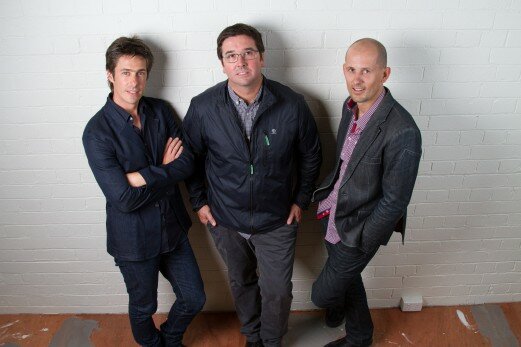
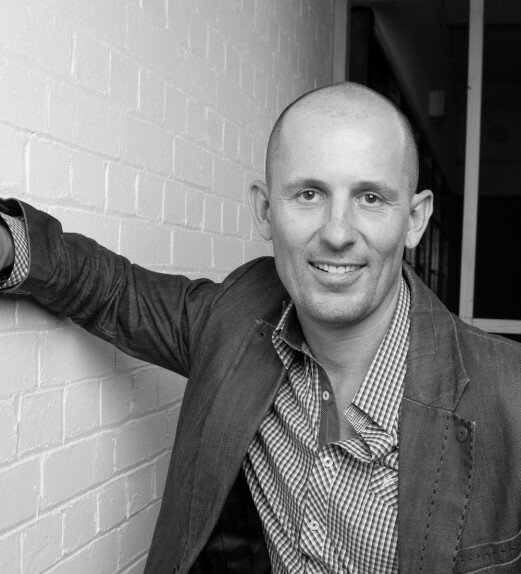
Jon Clements – Australian Institute of Architects Victorian Chapter President
I was always designing and building things when I was growing up, particularly model aircraft, and in many respects it was an important creative outlet for me. When I did HSC in my final year at secondary school I combined art with maths science which was a bit unusual at the time but it left me with the flexibility of pursuing different career paths. I was always interested in a unique work lifestyle, and felt that architecture was complementary to my existing skill set. When I was about 16 or 17 and I was finishing high school I had a keen interest in becoming a pilot. I thought carefully about what would provide the greatest depth in my life – what would keep me constantly interested. I wasn’t sure flying was going to fulfill the creative outlets so architecture got up at the end of the day. Fortunately I have been able to continue my interest in aviation away from work and I feel that I successfully balance my two passions.
I grew up around flying and architecture, and kept my flying interest going alongside my career.
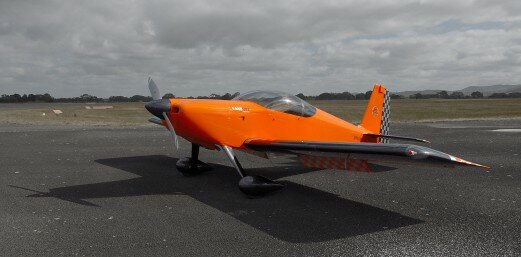
I studied at Deakin University in Geelong, where it was hard not to engage in the lifestyle aspect of regional university life – hang gliding was one of my other interests. Flying definitely provides a great outlet however I also find that it is closely related to architecture in terms of three dimensional thinking and spatial visualisation. My interest in flying eventually culminated in building an entire aircraft – the project took five years and interestingly it felt like an extension of my architectural skills due to the involvement of more technical engineering aspects and documentation processes.
Over my career I have been continually interested in creating a collaborative practice. At Jackson Clements Burrows I feel that I am able to extend my skill set whilst we pool our talents in order to get the best possible outcomes. My interest in architecture is primary cultivated through the enjoyment I get from working collaboratively with by business partners (Tim Jackson and Graham Burrows) and our team in the office. For JCB, the best project outcomes are founded on collective contributions between the client, architect, consultants, artists, and builders.
My biggest concern with the state of architecture in Victoria is the progressive shift towards offloading unreasonable project risk onto Architects.
In recent years there have been some substantial shifts in the way architects and projects are procured. One of the greatest concerns is that architects have become targets for offloading project risk. Procurement contracts are radically departing from previously established industry standards to shift the project risks from the clients to the architect and the associated risks are completely out of balance. This is a substantial challenge for architects particularly those providing services in the private and government development sector. At the same time the significant professional value of architects (which is protected by legislation) has been watered down by a number of less than professional project managers who do not hesitate to reduce the extent of architects services in the interests of saving money or (in some cases) lining their own pockets. One has to ask how the industry has been allowed to shift into to a “normal” situation where the Architect is expected to carry more risk and provide less service. The other contributing factor is that our built environment is now forced to continually accept substandard project outcomes that are far from best practice.
A positive aspect of the current Victorian planning scheme is that it still provides a lot of opportunity for experimentation at the smaller scale.
I think some of the best and most creative architecture is happening at the smaller scale in Victoria. Interestingly I think that is ultimately the planning constraints that apply at this scale that drive architects to be more creative in the interpretations of the standards and there is enormous talent working in this space in Victoria at the moment. When you analyse Melbourne’s taller buildings, there are some excellent architectural outcomes however the majority of our recent tall buildings lack innovation on both a creative and environmental level. In many cases I think it is fair to say that developers are driving the outcomes in front of the architects with a cookie cutter approach to producing one and two bedroom apartments at the cheapest prices with little or no regard for amenity. Little creativity is left to the architect often resulting in “seen it before” glass curtain walls with token trickery and unnecessary decorative elements. Sadly developers who have overpaid for sites have been squeezing the creativity out of this space in the interests of rebalancing feasibilities and it has an enormous impact on the reading of our city. Fortunately however the Victorian Government Architects Office has been addressing some of these issues in the last couple of years with the introduction of Design Review Panels and a concerted effort to ensure that apartment buildings achieve higher environmental and amenity standards.
Heritage is even more important for a young city – unfortunately so much of our heritage fabric has been lost.
Unfortunately many of Melbourne’s significant heritage buildings have been demolished over the past century. Increasing our awareness of heritage protection is an important part of understanding our city and preserving Victoria’s rich cultural background. It is important to understand that even relatively new buildings (and places) should be considered for Heritage Protection where they have made a significant contribution to the development of our young city. Heritage means different things to different people and it is important that we provide balanced consideration which accommodates public opinion where appropriate. Whilst Heritage protection puts pressure on future development propositions I believe that it should be embraced as an opportunity rather than a constraint.
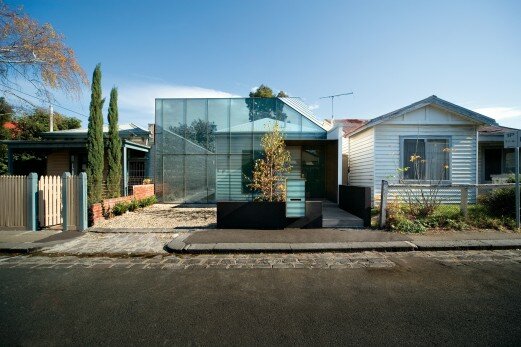
My favourite project that I have worked on is the “Old House” in Tyson Street Richmond.
Why? Because we feel that the project helped to raise awareness of the complexities associated with redevelopment in Heritage protected areas. The project stirred up a lot of debate from different camps however irrespective of points of view we felt that the discussions were important. We were hoping to demolish the existing house which had very little heritage value other than contributing to the general preservation of the streetscape. By photographing the Old House and applying a supergraphic of the image at 1:1 scale on the façade of new house we were effectively embracing the preservation argument through an ironic gesture. For me, it wasn’t about saving the building structure – if there was a point to it all, it was about allowing the legacy of the original house and its place in the street to survive in a surreal way.
When faced with the challenge of working on heritage projects we are absolutely committed to the importance of longevity rather than pursuing a path which rehashes the past. For Jackson Clements Burrows architecture is about embracing the opportunity to create something special from a unique set of circumstances. We never start a project with a preconceived idea of what the outcome will be – what is important to us is that the process can adapt to various influences and changes in circumstance while the design evolves.
Some of our best projects involve a collaborative attitude from the client that leads you to a place that you didn’t expect to go.
For more information: www.jcba.com.au